
 One of the best things about having gone to culinary school in San Francisco is that there really is no other place in this country where everything comes so neatly together. There are three world-class wine regions within an hour’s drive, there are all sorts of fresh seafood (both fin and shell fish) coming in from the Pacific ocean and the San Francisco bay, and best of all, California has all sorts of farmers’ markets where local farmers will sell their wares. Even the local 7-11 carries varieties of food and wine that you have to go to Dean & Deluca to get here.
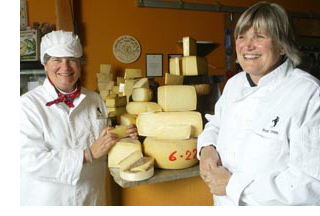
While I was out there, I indulged in the guilty pleasure of practically every other chef in town: cheese. For most of us, Whole Foods served as our local dealer (really, it is very similar to crack cocaine, you give the guy behind the counter a ten-spot, and he gives you a “rock” of the latest and greatest cheese they have). It was at a local market that I became aware of one of the best cheese-makers in the Bay area: Cowgirl Creamery. Founded by two women that were no strangers to the culinary world, Cowgirl Creamery quickly gained a very good reputation for turning out some of the tastiest cheeses around, simply by being extremely fussy over the ingredients they chose to use.
In addition to a very tasty creme fraiche, the folks at cowgirl creamery make a very addictive cottage cheese (we’re not talking Breakstone’s here), and a classic fromage blanc to round out their fresh cheeses. As for their aged cheeses, I like the Mount Tam (named for Mt. Tamalpais in the north bay), and the St. Pat, which is their seasonal spring cheese, wrapped in stinging nettle leaves (the leaves are washed and frozen first to remove the sting), which impart a smoky artichoke flavour. Their Pierce Point cheese, which is only produced in the fall and winter, is washed in a muscato wine, and rolled in dried herbs from the Tomales bay coastal region, which produces a complex yet not overpowering cheese.
The reason I’m telling you all of this is because the women that founded Cowgirl Creamery are originally from this area, and they have just opened a store in the Penn Quarter of the district (right down the street from the newly renovated Smithsonian National Portrait Gallery). In addition to cheese, their store here also sells charcuterie (cured meats, among other things), local breads, and wines. Check it out!
Cowgirl Creamery
919 F Street NW
Washington, DC 20004
(202) 393-6880
-
02Aug
-
28Jul
The Ballston Farmer’s Market debuted last summer, and only had a few vendors. This year, the market is back with many more vendors. The market is open Fridays 11am until 3pm, through October 13. It is interesting that this particular market does not have many produce vendors.
Sunnyside Farms sells organic produce, apple cider, and flowers.
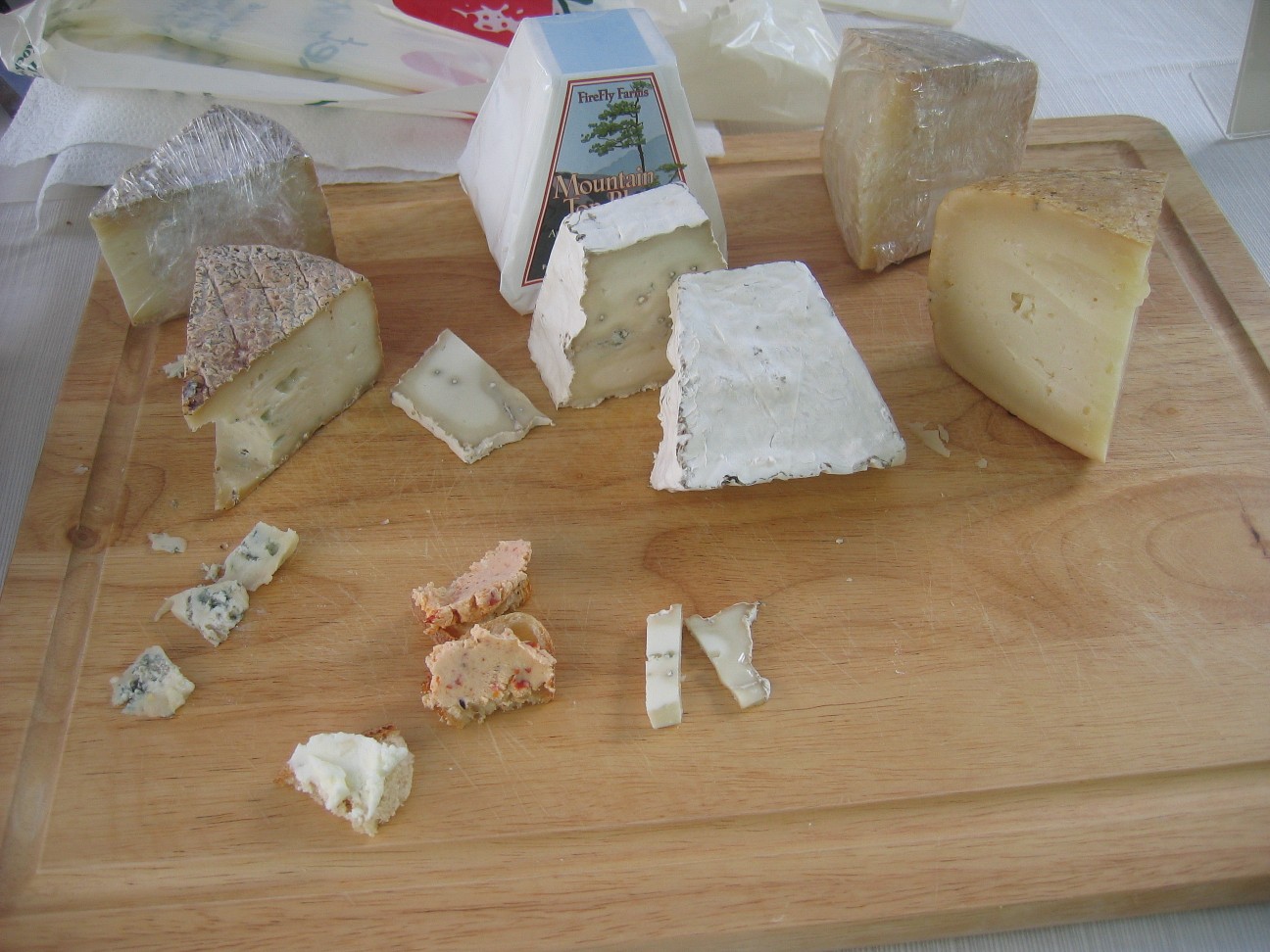
I am very impressed with Firefly Farms goat cheeses. They are some of the best I’ve had, and all of Firefly Farms cheeses have won awards. Besides the cheeses listed here, they also brought two spreadable cheeses today. One is sweet and has ginger, almond, and honey, and the other is savory, and has sun dried tomato, herbs de Provence, and roasted garlic. Check here for a list of stores and restaurants that carry or use their products.
Baguette Republic of Falls Church is also present, and a good selection of hearty breads. They also sell at the Clarendon Farmer’s Market.
I have been eyeing Virginia Lamb’s stand, but have not yet purchased their products.
I have tried Old Pioneer’s Kitchen’s Argentine Chorizo, and chimichurri sauce. Both were good, although unlike theirs, the Argentine-style sausages I am used do not contain both pork and beef. I hear that their Mexican chorizo is good as well.
Arondo of Hondo Coffee owns a plantation in Honduras, and roasts the beans in Stafford, Va. They sell several roasts, and the coffee is quite good. And, the coffee smells so good.
Dick’s Kitchen makes and sells various sauces, jellies, seasonings, and chutneys. His “Oh My God, Oh My God” hot sauce was sampled at a gathering of DCFUD writers. I believe that DCFUD’s editor has promised an article about that particular hot sauce tasting. 🙂
Great Harvest Bread Company in Alexandria is at this market as well. I have a friend that loves their biscotti.
Virginia Green Grocer and Grace’s Pastries are present as well, although I have not tried their products.
The market also has live music at noon, and cooking demonstrations from area restaurants at 1:30 pm. Today, 1 Gen Thai Cuisine (a new Ballston restaurant) demonstrated several dishes. They made chicken satays, fried rice, and somethign similar to a vietnamese summer roll. Willow has already demonstrated dishes on two occasions, and Sangam Restaurant was featured last week.
And…I saved the best for last…many of these vendors provide samples. Firefly Farms, Baguette Republic, Grace’s Pastries, Hondo Coffee, and Great Harvest Bread Company have samples on their tables. Dick’s Kitchen has samples of some products, but you have to ask for them. And, you get to sample the dishes that are featured during the cooking demonstrations. -
25Jul
 Any reader worth her Kosher salt knows our obsessive coverage of all things Splenda. Yet, it seems there are those out there who still do not embrace the joy of hydroxyl-chlorine substitution. How could this be?
Perhaps it’s Splenda’s dubious history: Two scientists in England were trying to create an insecticide. One asked the other to test the new white powder they’d concocted. In accordance with official Crappy English Humor laws, it was misheard as a request to taste it. Thus, sucralose was born.
As a humorous footnote to that story, Splenda has since been tested on numerous cute squeaky things…to delicious results!
But if we still haven’t convinced you, here are some other low-cal powders to dust on your latte.
Xylitol – Also called Birch sugar, this stuff comes from raspberries, plums, corn, and, yes, birch. But to wrap your tongue around this sweet substitute, you’ll have to go to Finland, its ‘home country’. Also Japan and South Korea, if you’re willing to stick with gum. I think Trident uses it too.
Pro: Repairs cavities, osteoporosis, and ear infections, no I’m totally serious.
Con: Wait for it…it’s a laxative. Oh, and can cause loss of coordination, depression and seizures.
Maltitol – It doesn’t decay teeth and has less calories. And it can be synthesized from regular everyday starch.
Pro: ‘Baked goods’
Cons: ‘Gastric Distress’
Isomalt – Like sucrolose, it’s also produced from sugar. Unlike sucrolose, it has about the same volume too- Find this stuff in Candy, coffee, and chocolate.
Pros: Also repairs cavities, feeds good bacteria in the system, and of course, it’s sweet.
Cons: Still has a decent chunk of calories, and has to be mixed with another sweetener to get it to sugar levels. And diarrhea
Stevia – Actually a type of herb, the ‘steviosides’ in it are 300 times sweeter than sugar. Folks go crazy for it in Japan, but you can also smuggle it in from China, Korea, Thailand, Malaysia, Israel, and parts of South America.
Pros: Well, the US has labeled it unsafe at the request of an ‘anonymous food complainant’. As the various lawsuits against Splenda have proven, these always turn out to be actually filed by the competition. If Sweet n’ Low is worried, you can probably be pretty sure it’s good.
Cons: A faaaaint possibility of depressed male vitality. If you get paranoid about Mountain Dew, this ain’t the sweetener for you. -
07Jul
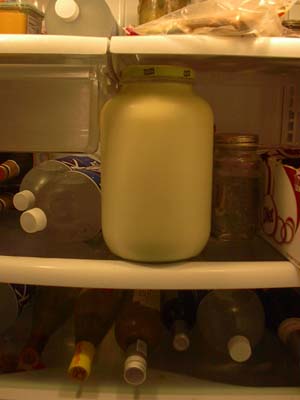 ‘Th’state says I can’t sell that to you’
What do you do with it?
Well, I do got seven kids…
How about I pay you for a reeealy expensive chicken, and you give me the milk as a present?
I c’n do that…
In southern Virginia there has been an unlikely meeting of the minds on the subject of organic farming. The hippies do it to live a natural lifestyle and to take power away from the man. The far right does it for the same reason they homeschool: ‘ I jus’ wouldn’t put that stuff they sell into my kids.’
Raw, organic, unpasteurized, non-homogenized milk may not be for kids or pregnant folks, and of course, technically it’s illegal. As a rule of thumb, drink without guilt if you’re comfortable eating chocolate mousse; the infection risk is about the same as that posed by raw egg whites (tho the diseases can be worse). This is what we did with the raw milk of Louisa the Jersey cow:
We drank it. Raw milk tastes like a thin, sweet, milkshake.Because the cream had risen out into a sluggish, yellow strata on top, a straw helped get down to the layer below.
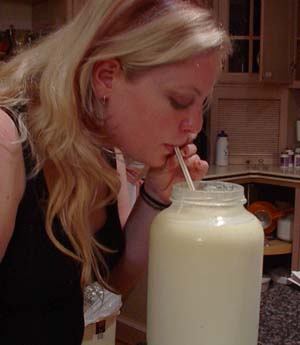
Some folks didn’t bother with such advanced technology
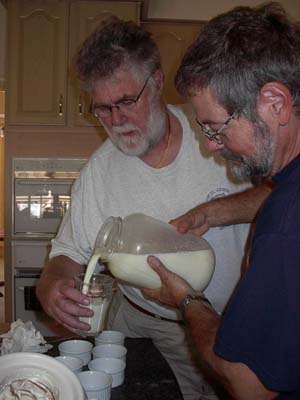
Then we skimmed off the top layer of cream…
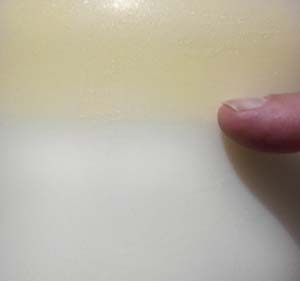
…and yeah, we whipped it up and stuck it on pie and in some coffee and stuff, but mostly, we made butter. Here’s how it’s done.
All-natural, organic, silky, wonderful butter
If you aren’t lucky enough to have an entrepreneurial farmer nearby, I suggest starting with heavy organic cream. Get the most natural, hormone-free stuff you can find. I know Whole Foods has it, not raw but as close as you can buy ‘round here.
Pour about 2 pints…or as much as you want really, into a blender. I found out the hard way that using regular beaters doesn’t cut it. Blend on high for about 7 minutes. First it will whip up, then it’ll deflate back down and start getting all grainy-looking.

Use a Pulse setting to keep churning until the grains are blobby and fully separated out into yellow butter and white buttermilk.
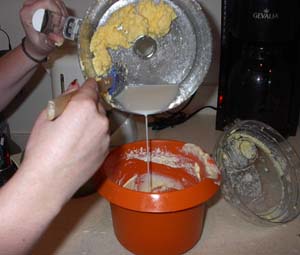
Now wash it! Take a bowl of ice water and stick your hands in it till they’re totally cold. Scrape the butter in, and pat the little blobs into…a big blob. Don’t worry, it won’t dissolve in the water. I mean, it’s butter.
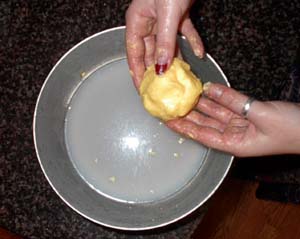
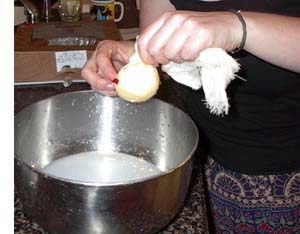
Wet down a cheesecloth or some similar, stick the butter in and twiiiiist. Gently. That’ll get rid of the extra buttermilk and water.
That’s it! stick it in a dish. cool it down. put it in your mouth.I can’t beleve it’s butter!
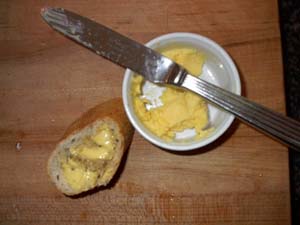
MHF demonstrates the correct eating technique
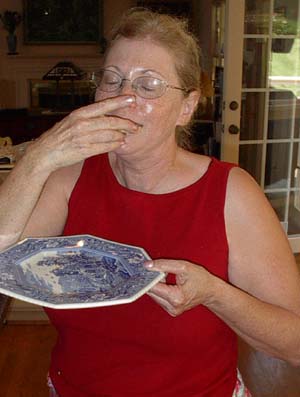
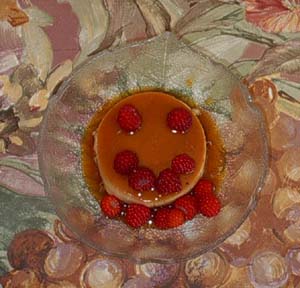
Oh, and we also made some Flan. Lots of Flan. Recipe in Part 2.Thanks Louisa! -
13Jun
 Where oh where did American yogurt go so wrong? How come mostly all that is sold is a uber-sweet fruit flavored cup of gelatin-filled pudding or chalky-thin no-fat Dannon plain? Whatever happened to tangy, creamy, healthy, dairy fresh-tasting yogurt? Like the kind that is sold in every store in Europe?
Happily, about a year ago I suddenly became aware of Greek yogurt. Where it was before that I have no idea. I had never heard of it and then … it was everywhere, in every Whole Foods, natural foods store, Trader Joe’s and upscale grocery. It comes in full fat, 2%, and no-fat tubs, not individual serve cups, and (I swear this is not a prepaid ad) is called Fage Total Greek yogurt brand. It is supposed to be the #1 brand actually sold in Greece. There is no excuse to ever buy the thin chalky or yucky sweet stuff again. Ever.
First of all Fage yogurt still has all the active microorganisms that commercial yogurt manages to kill in the processing. You know, the stuff that originally made yogurt a (maybe THE) original Health Food. Now Dannon its promoting its (fruit filled, sugary) Activa brand – yippee, big deal. Its hook is that one of Dannon’s huge line is actually what is supported to be – yogurt that still has live acidophilus bacteria to support and maintain a healthy digestive tract.
Second, Total is VERY thick and very creamy. It is an excellent substitute for sour cream, thin cream cheese, or even mayo in many recipes. If you want sweet or fruity just add some jam or sugar (try brown – lovely!) Their website does list fruit-flavored ones but I’ve never seen any except the plain, so maybe they are sold only in Greece. I actually like the full-fat but the others are much superior to other low or no-fat yogurt. Truly delicious. Wish I knew how to say that in Greek.
BTW, Trader Joe’s does have a line of its own of Greek and also what they call Mediterranean yogurt. Not bad — but not as good as Fage Total. Sorry Joe.
This post is by bacteria activist and guest blogger MHF -
11Jun
 Doug asks: Why it is that my burgers never turn out to be “restaurant quality” when I grill?
Chef Yaneev writes: This, actually, is a very common question. Generally, people who have burgers that aren’t quite what they expected tend to make one of two mistakes. They’re either making their patties too big (which is bad because by the time the middle of the patty is cooked to temperature, the outside is charred beyond belief – a good burger should be no more than three-quarters of an inch thick), or they’re using beef that is too lean (see the tip in my last post about fat).
Joanne asks: Is it necessary to sear meat in hot fat before stewing or braising it in broth or water?
Chef Yaneev writes: Many chefs have different reasons for doing this (or not doing it). One common answer is that this “locks in the juices.” Unfortunately, that’s not true. The reason that those chefs who opt to sear meat do so is because searing meat gets the outside of the meat hot enough to brown, which adds flavour. Any food cooked solely in water or broth never gets hotter than the boiling point of water (212 degrees Farenheit at sea level). Browning in fat allows the outside of the meat to reach much higher temperatures – usually 300 to 500 degrees. Those high temperatures quickly create intense flavours, rich brown colours, and crackling crusts. This is due to a chemical reaction called the Maillard reaction, where carbohydrates react chemically with amino compounds in proteins to create browning, deeper flavours, and great aromas. Personally, I always sear meat before stewing or braising it. Some chefs disagree, but hey, the flavour difference is certainly there.
Rob asks: If veal is essentially young beef, shouldn’t it be thought of as a more tender “cut” (i.e. more suitable for drier cooking methods)? Why is it that almost every recipe I’ve seen for veal involves moist cooking methods?
Chef Yaneev writes: Have you ever noticed that at a lot of restaurants, veal isn’t really done right, and winds up tasting like you’re eating a tire? That’s because they usually use drier cooking methods. Veal has a high proportion of connective tissue to muscle fiber because the young animal has not had time to put on extra weight. However, because it’s a young animal, veal’s connective tissue is more soluble than that in beef. Cooking veal with moisture (i.e. a moist cooking method) therefore makes sense because it allows that connective tissue to soften.
Got a food question you’d like me to answer? Send them into to dcfud.writers@gmail.com, and I’ll answer them in my Ask a Chef column. -
08Jun
Since this is my first posting for DCFüd, what better way to start than a post about one of my true loves in life: barbecue. Of course, now that summer is pretty much here, people will be firing up the grills and enjoying that great summer flavour. As a professional chef I have opportunity to see some of the best and worst of barbecue ideas, so I thought I’d post some tips here.
Use The Right Heat For The Job. There are two types of heat for food on a grill – direct and indirect. With direct heat, you spread your coals out evenly (or cook directly over the burner on a gas grill), and cook directly over the hot coals. This works very well for burgers, hot dogs, and items that don’t cook for all that long. With indirect heat, you pile your coals to one or both sides of the grill, and leave the middle empty (or switch the side burners on, and leave the middle off) or with a pan for drippings. You’d then put your food in the middle, so the heat is more even. This works for foods like chicken, that typically cook for longer.
Fat Is Good. While most health-care professionals will advise you to limit your fat intake, when you’re barbecuing, you need to choose meats that have good marbling. Fat will keep the meat moist over the high heat, which will prevent it from drying out (chicken and/or turkey should always be grilled with the skin on – you can always take it off before eating it). When grilling any kind of meat with a fat cap, always start the grilling fat side up. Turn it over about three-fourths of the way through.
Avoid Excessive Flipping. Give your food time to cook, and don’t be worried about it. This is especially true for burgers and steaks, which should only be flipped once. Any more than that, and you lose the juices in the meat. If you’re using the right heat method, you won’t need to flip very often.
Try New Things. Try grilling some fish, or vegetables. Yes, even the vegetables you don’t like take on a whole different flavour when they’re grilled, so why not try some veggie kebabs? For a really nice touch, grill some fresh fruit (not for very long, mind you, but just enough to accent the natural sweetness of the fruit). That works for everything except watermelon (and to eat watermelon any way other than the normal way is just downright un-American if you ask me).
This post is by Guest Blogger Yaneev. Thanks, mister! -
08Jun
 Today’s Haiku:
I dreamed of cupcakes
Covered in chocolate sprinkles.
My pillow’s missing
Today’s Lunch spot:
Jonathan’s Gourmet Deli – This place takes their salads very seriously.
Today’s recipe: Spicy Potato Skins
4 large potatoes
1/4 cup olive oil
1 teaspoon salt
1/2 teaspoon ground black pepper
1-1/2 teaspoons chili powder
1-1/2 teaspoons curry powder
1-1/2 teaspoons ground coriander seed
Preheat the oven to 400 degrees.
Bake the potatoes for 1 hour. Slice the potatoes in half lengthwise, and let them cool for 10 minutes. Scoop out most of the insides, leaving about 1/4 inch of squish against the potato skin. Cut each potato into three pieces and brush with olive oil. Combine the salt and the spices and sprinkle the mixture over the potatoes. Bake the potato skins for 15 minutes or until they are crispy and brown. -
18May
Fud’s obsession with Splenda is a beautiful thing, especially on dry news days when we can’t be bothered to, you know, write anything real.
But if you thought we were ridiculous, check out Dr. Janet Starr Hull’s book: Splenda®: Is It Safe Or Not?.
Now, no one gives something a title like that if the answer is “why yes, yes it is, completely harmless. Sorry to cause the fuss”. But this book doesn’t stop there, it promises to save your children from toxins, and identify the cause of ‘vague health symptoms that puzzle your doctor’. I deeply suspect it will also walk your dog, reconcile you with your ex, and make your teenage son love you again.
It’s only deep into the website that the true oddness pops up- Hull is a Saccarine fan! Yes, despite the ‘misleading report 20 years ago’ that it causes cancer, Saccarine and not Splenda is the answer to all your problems. In case you didn’t get the picture, she advocates you to use the packet’s color coding: Yellow(Splenda) means caution, whereas the happy pink of Sween n’ Low means sweet safety!
Yet, this is only the second book that our good doctor has published. Her first one is “Sweetpoison“, a book on the dangers of Aspartame (NutraSweet). its description is surprisingly similar.
I can’t help feeling like maybe Dr. Hull, who lists her qualifications as “.. Licensed Certified Nutritionist, certified fitness professional, author and aspartame victim”, should maybe be taken with a grain of salt. -
09May
Many people spend their whole life searching for perfection; the perfect outfit, the perfect diet, the perfect job. I am proud to say that, while I have yet to find perfection in any of the above, I have located the perfect brownie. It is a thick and rich brownie, with a moist, fudgy, faintly chewy interior. There are walnuts too! The top is a thin layer of chocolate, with mini marshmallows and caramel swirls.
However, this brownie is difficult to procure. It can only be purchased during four periods a year, with each period composed of 4 days. In addition, it is a costly brownie, ranging from $26 for students up to $135. There is also a dress code to buy the brownie; black tie is not required, however a certain amount of formality is defiantly de rigueur.
At this point you may be wondering if the brownies are gold-plated, or made by Julia Child (the latter would be particularly interesting as she is dead). However the truth is less exciting. You see, with every brownie purchased, one gets to see a free performance of the Baltimore Opera Company. Or, to put it another way, you can only buy the brownies at the dessert pavilion at the Baltimore Opera company during the intermission of one of the performances. Attempts to convince to the BO staff to let the author simply run in and purchase a brownie have been unsuccessful thus far. Attempts to discover the source of the brownies has met equal results. Thus, this brave author every couple of months puts on her high heels and pearls, purchases a ticket, and travels to the opera house to buys her brownie. And usually stays for the show.
